
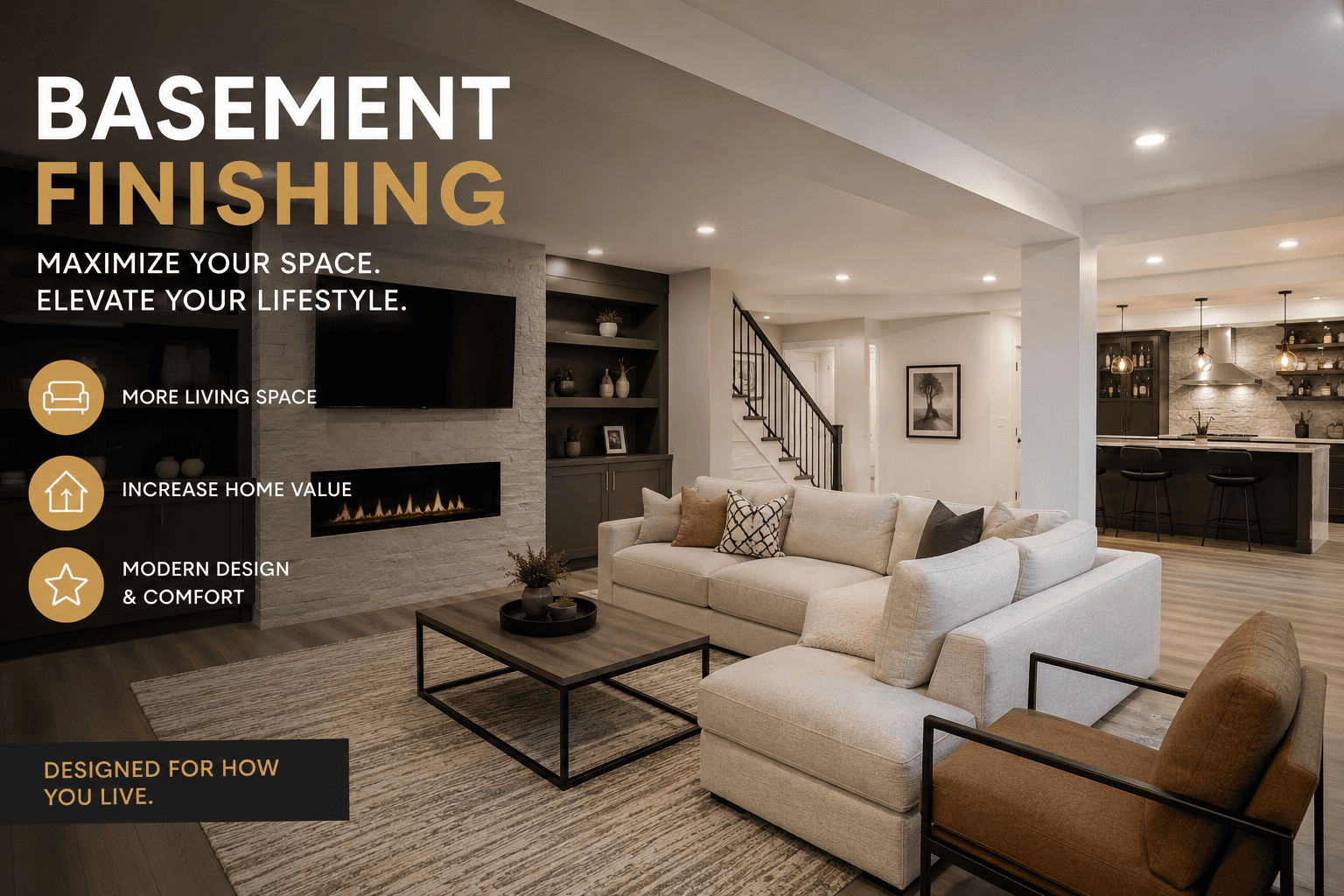
An unfinished basement is the single biggest piece of underutilized real estate in most Greeley homes. A typical 1,200 sq ft basement that finishes well can add 30-50% to your home’s livable square footage at roughly half the per-foot cost of new construction — and unlike an addition, you don’t need a building footprint or new foundation. The structure is already there. The question is just what to do with it.
This guide is a Greeley-specific basement idea book. We’ll walk through 18 of the most popular finished-basement use cases we’ve built across the city, plus design tricks for the low-ceiling basements common in 1950s-1980s Greeley ranches, daylight strategies, egress and radon realities, ADU options under Colorado HB 24-1152, and a realistic cost-and-budgeting framework so you can plan rather than guess.
Why Finish Your Greeley Basement?
Before the design ideas, a quick honest look at what finishing actually does for a Greeley home:
- Adds livable square footage at roughly half the cost of building new above-grade. New construction in Greeley runs $200-$300 per finished square foot in 2026; basement finishing runs $35-$120 per finished square foot depending on tier.
- Improves resale appeal. Finished basements consistently appear in the top features Greeley buyers search for. Per Remodeling Magazine’s Cost vs. Value reports, basement finishes typically recoup 60-75% of project cost at resale — comparable to most major renovations.
- Solves family-stage problems without moving: kids need their own space, in-laws need to move in, you want a home office, you’ve been wanting a gym, you bought a pool table you have nowhere to put. The basement is usually the answer.
- Improves energy efficiency. Insulating and air-sealing the basement perimeter as part of the finish typically reduces total household heating and cooling costs by 5-15% in Greeley’s climate.
- Income potential if structured as an ADU under HB 24-1152 (effective June 30, 2025) — a finished basement with proper egress, a kitchen, separate entry, and HVAC separation can be rented as an accessory dwelling unit on most Greeley single-family lots.
Greeley Basement Realities Before You Design
Greeley’s housing stock is unusually diverse, and the basement you’re working with depends heavily on when the house was built. The two big variables:
Ceiling Height
- Pre-1960 downtown and west Greeley: Often 7'-7'6” finished ceilings — below modern code-minimum of 7'6” in some cases (which still grandfathers in for finished-area use as long as nothing is moved). Design needs to compensate.
- 1960s-1980s Greeley ranches: Typically 7'6”-8' finished ceiling. Workable but tight for premium designs like coffered ceilings.
- 1990s-2000s Greeley: 8' typical, sometimes 8'6”.
- 2000s-2020s east Greeley / Promontory / Boomerang Estates: 9' standard, sometimes 10'. This is where premium design moves (coffered ceilings, beam details, tall doors) really pay off.
What’s Already Roughed In
- Bathroom rough-in: Most homes built 1990s and later. Toilet flange in slab, drain stubs, supply stubs. Standalone basement-bath finish-out runs $10,000-$22,000 from this starting point.
- Egress windows: Required by code in every basement bedroom. Most homes built 2000s and later have at least one egress window already; older homes typically don’t and you’ll need to add ($2,500-$7,000 each).
- Sump pump: Newer homes have builder-installed sump pumps in a sump basin. Older Greeley homes often don’t (and don’t need one if the lot drains properly).
- HVAC supply runs: Newer homes typically have ductwork stubbed for future basement supply; older homes may need significant HVAC work.
- Radon mitigation: Per the EPA, Weld County is partially in Zone 1 (highest predicted radon levels). A radon test before finishing is strongly recommended; if elevated, a mitigation system runs $1,200-$2,500 and is best installed before sealing up the basement.
Idea 1: The Multi-Function Family Rec Room
The anchor of about 80% of Greeley basement finishes. A flexible open space that handles TV/movies, board games, kids playing, casual entertaining, and overflow for family gatherings. Typical footprint: 400-700 sq ft inside the larger basement.
Design ideas:
- Open floor plan with no interior walls between the “living” zone and an attached wet bar or game area — lets the room flex by activity.
- LVP or engineered hardwood instead of carpet. Carpet visually signals “basement” and shows wear fast in high-traffic rec rooms. Continuous hard flooring throughout reads “main level.”
- Recessed cans on multiple dimmer zones for movie nights, board games, and bright play.
- Wall-mounted TV with built-in cabinetry to hide media equipment and console clutter.
- Sectional sofa with hidden storage cube ottomans.
- Walk-in or reach-in storage closet for board games, holiday decor overflow, and stuff that doesn’t belong upstairs.
Idea 2: Dedicated Home Theater Room
For households where movies are a Saturday-night event, not just background TV. Dedicated theater rooms are most popular in premium Greeley subdivisions (Promontory, Boomerang Estates, Westview), but the basics work in any basement with 9-foot ceilings and a 12' x 16' or larger room.
Design ideas:
- Tiered theater seating (two rows of recliners on a 10”-12” riser).
- Projector + 100”-120” screen or large-format 75”-85” TV (depending on viewing distance).
- Acoustic wall panels (designer fabric-wrapped, not the bare-foam-pad look).
- Blackout drapes or no windows at all (a windowless interior basement room is actually ideal for theater).
- In-wall or in-ceiling speakers for 5.1 or 7.1 surround.
- Dedicated 20-amp electrical circuit for AV rack; recessed wall niche for equipment so cabinets aren’t crowded.
- Star-field fiber-optic ceiling for the premium-tier theater experience.
- Theater-themed accent wall (movie posters, marquee lighting).
Idea 3: Wet Bar & Entertainment Hub
Of the most-requested Greeley basement features, the wet bar is in the top two. Scope ranges from a basic 6-foot bar to a full custom kitchen-style installation.
Design tiers:
- Basic mini-bar ($2,000-$5,000): Counter, mini-fridge, basic cabinets, no plumbing (drinks brought in pre-prepared).
- Standard wet bar ($4,000-$10,000): 8' bar, sink with garbage disposal, mini-fridge, basic upper cabinets, quartz counter.
- Premium wet bar ($15,000-$40,000+): Full custom cabinetry to ceiling, wine fridge, ice maker, dishwasher, beverage center, dual sinks, tile backsplash, statement pendant lighting, bar seating for 4-6.
Design ideas:
- Floating glass shelves with LED backlighting for liquor display.
- Backlit onyx or quartz counter for visual drama.
- Wine fridge built into the bar cabinetry (or a separate adjacent wine wall).
- Bar seating with custom-height stools (typically 30” counter height or 42” bar height).
- Designer pendant lighting in groups of three over the bar.
- Match the bar finish to your kitchen upstairs — or deliberately contrast (e.g., dark moody bar paired with a light-and-bright kitchen).
Idea 4: Home Gym with Rubber Flooring
Post-2020 demand for home gyms has stayed strong. A 200-400 sq ft basement gym room handles cardio plus moderate strength training for most households.
Design ideas:
- Rubber flooring ($3-$8 per sq ft installed): rolled rubber or interlocking tiles. Critical for shock absorption and equipment protection.
- Mirror wall covering one wall floor-to-ceiling to check form during lifts.
- Dedicated 20-amp circuits for treadmills, ellipticals, rowers, and Peloton-style equipment.
- Dedicated HVAC return air to handle the heat and humidity from exercise — a mini-split is sometimes the right answer for true climate control.
- Wall-mounted TV or projector for follow-along workout videos.
- Sound system for workout playlists (in-ceiling speakers or Sonos).
- Storage wall for free weights, kettlebells, resistance bands, foam rollers, yoga mats.
- Pull-up bar mount in framing during construction (anchor points are much cheaper now than retrofitted later).
Idea 5: Guest Suite (Bedroom + Bath + Sitting)
For households with extended-family visits, college kids returning home, or post-pandemic guests wanting privacy. A basement guest suite typically includes:
- Bedroom (with required egress window).
- Full bathroom (or 3/4 bath with shower).
- Small sitting area or den.
- Optional kitchenette (sink, mini-fridge, microwave).
- Walk-in or reach-in closet.
Design ideas:
- Hotel-suite feel: high-end bedding, blackout shades on the egress window, plush carpet or large rugs over LVP.
- Spa-style bathroom with walk-in tile shower (Schluter Kerdi waterproofed), heated floor, statement vanity.
- Kitchenette on a back wall — small counter, beverage center, microwave, sink — for guest comfort without needing to go upstairs.
- Smart locks on the guest suite entry for privacy.
- Dedicated HVAC zone so guests control their own thermostat.
Idea 6: ADU / In-Law Suite Under HB 24-1152
Colorado HB 24-1152, effective June 30, 2025, requires qualifying jurisdictions including Greeley to permit at least one accessory dwelling unit on single-family-zoned lots. Basement ADUs are typically the most cost-effective ADU option because the structure, foundation, and most utility connections already exist.
To convert a basement into a legal ADU:
- Full kitchen with range, refrigerator, sink, cabinets, counter, plumbing tie-in.
- Code-compliant egress for the entire living space, not just bedrooms.
- Separate entry — either via existing walk-out, a new exterior stairwell with bulkhead door, or a basement-level egress door.
- Separate HVAC zone with independent thermostat control.
- Fire separation between primary residence and ADU per International Residential Code.
- Independent address signage and sometimes separate utility metering (varies by Greeley rules).
Typical cost: $50,000-$120,000 for an attached basement ADU. Best fit: walk-out and daylight basements that already have natural light and exterior access. See our home additions service page for a comparison with detached ADU options on larger lots.
Idea 7: Teen Hangout / Game Room
For families with teenagers, a dedicated teen zone in the basement gives them their space and gets them out of the main living room.
Design ideas:
- Sectional sofa or modular floor seating.
- Wall-mounted large-format TV.
- Gaming setup: dedicated gaming PC station, console setup, or both, with cable management built in.
- Pool table, ping pong, foosball, or air hockey.
- Mini-fridge for snacks and drinks.
- Charging station wall with USB outlets and headphone hangers.
- Acoustic wall panels (teen movies + gaming + music gets loud).
- Connected adjacent half-bath so they don’t come upstairs every 20 minutes.
Idea 8: Kids’ Play Area & Imagination Zone
For families with younger kids, a basement playroom keeps toys out of the main living area and gives kids a dedicated “their” space.
Design ideas:
- Durable, easy-clean flooring: LVP or rubber sport flooring. Avoid carpet (marker, juice, slime).
- Whiteboard or chalkboard wall for endless art.
- Built-in toy storage: bins, cubbies, low shelves at kid height.
- Reading nook with built-in bench and tucked-away book storage.
- Indoor climbing wall on one wall section (real climbing holds bolted into reinforced framing).
- Tent or fort area — a corner reserved for indoor camping.
- Adjacent half-bath for quick trips.
- Connected office or sitting area so a parent can work nearby while kids play.
Idea 9: Home Office or Detached-Style Workspace
Post-2020, dedicated home offices stayed in demand. The basement office gets you away from the upstairs noise and signals “real work” vs. the corner-of-the-kitchen-table setup.
Design ideas:
- Acoustic privacy: proper wall insulation (Rockwool or fiberglass batts), solid-core door, weatherstripped door bottom. Important for Zoom calls.
- Dual-monitor desk setup with cable management built into wall panels.
- Built-in bookshelves or wall-mounted shelves for reference, awards, decor.
- Dedicated 20-amp circuit for computers, monitors, and equipment.
- Lighting plan: ceiling cans on dimmer + a separate desk lamp + a separate accent light for video-call appearance.
- Egress window if the office is used for >4 hours a day — daylight matters for mental health and Zoom call quality.
- Murphy bed on one wall if the office doubles as a guest room.
Idea 10: Hobby Studio (Craft, Art, Music)
A dedicated space for whatever you make. Quilting, painting, calligraphy, model building, electronics, 3D printing, sewing — basement hobby rooms remove the “clean up every night so the dining table is usable” tax.
Design ideas:
- Counter workspace at 36” or 42” height (sitting or standing).
- Built-in storage for supplies: drawers, labeled bins, pegboard wall.
- Improved ventilation for art supplies or 3D printing (consider a small exhaust fan to exterior).
- Dedicated lighting — daylight-temperature task lighting (~5,000K) at the workspace for color-accurate work.
- Vinyl or LVP flooring (wipes clean) instead of carpet.
- Sink station for washing brushes, hands, or clean-up.
- Adjacent storage closet for bulk supplies and finished projects.
Idea 11: Wine Cellar or Beverage Room
For households who collect wine, whiskey, or specialty beverages. Basements are naturally suited to wine storage because temperature and humidity stay more stable than above-grade rooms.
Design ideas:
- Climate-controlled wine room (a small dedicated insulated room with a cooling unit) for serious collectors — maintains 55°F and 60-70% humidity.
- Wine wall (open shelving display) for casual collections without dedicated climate control.
- Floor-to-ceiling glass enclosure for a wine-room-as-feature look.
- Lighting: LED accent lighting that doesn’t heat the bottles, with dimmers.
- Wood racking (typically redwood or mahogany) for classic style, or metal cable racks for modern.
- Tasting counter with stools for pouring and sampling.
- Tile or concrete flooring (climate-resistant, won’t warp at lower temps).
Idea 12: Workshop / Maker Space
For woodworkers, electronics tinkerers, model builders, 3D printers, leatherworkers. A basement workshop typically needs more electrical and ventilation than a hobby studio.
Design ideas:
- 240V circuit for larger power tools (table saw, planer, lathe, kiln).
- Dedicated 20-amp circuits at workbench locations for hand tools and small machines.
- Dust collection system integrated into walls/ceiling for woodworking.
- Heavy-duty workbench built in or freestanding.
- Pegboard or French cleat wall for tool storage.
- Strong overhead lighting plus task lighting at workstations.
- Concrete or rubber-tile flooring (forgives drops, easy to sweep).
- Adjacent storage for raw materials — lumber rack, sheet-goods rack, hardware shelving.
- Ventilation to exterior for finishing work (paint, stain, varnish).
Idea 13: Library & Reading Nook
For households who actually read — physical books, dedicated quiet time, escape from screens. A basement library can be a full room or a corner of a larger space.
Design ideas:
- Floor-to-ceiling bookcases on one or more walls. Built-in cabinetry beats freestanding bookcases for the “real library” feel.
- Library ladder on a brass rail if shelves reach the ceiling.
- Window-seat reading nook built into an egress window opening — bench seating with cushions, built-in storage underneath.
- Comfortable seating: wingback chairs, deep armchairs, a chaise lounge.
- Task lighting: floor lamps with adjustable arms at every seating location, plus ambient ceiling lighting.
- Acoustic ceiling treatment for the “quiet library” sound profile.
- Optional fireplace (electric or gas with proper venting) for the classic library mood.
Idea 14: Yoga & Wellness Room
A quieter, smaller-footprint version of the home gym. Better for households who want meditation, stretching, light cardio, and mindfulness practice rather than serious weight training.
Design ideas:
- Bamboo or cork flooring — warm under bare feet, natural feel.
- Mirror wall for form checking.
- Built-in storage for mats, blocks, straps, bolsters.
- Sound system with calm music or guided meditation audio.
- Plants (real, if natural light supports them; high-quality artificial if not).
- Dimmable warm-temperature lighting on dimmers.
- Optional infrared sauna in an adjacent small enclosed area.
- Optional cold plunge tub for the full wellness setup.
Idea 15: Music or Podcast Studio
For musicians, podcasters, voiceover artists, YouTube creators — a dedicated soundproof room solves the upstairs-noise problem permanently.
Design ideas:
- Soundproofing: double-stud walls with Rockwool insulation, resilient channel, double drywall layer with Green Glue between, weatherstripped solid-core doors. Real sound isolation, not just “a quiet room.”
- Acoustic treatment inside: bass traps in corners, broadband absorbers on first reflection points, diffusers on the rear wall.
- Dedicated electrical: isolated audio-grade ground, dedicated 20-amp circuits for recording gear.
- Floating floor if the studio is above mechanical equipment — decouples vibration.
- Built-in equipment desk sized for monitors and interface.
- Vocal booth (closet-sized treated space) for clean voice recording.
- Climate control: dedicated mini-split (HVAC noise from main system is unacceptable in a recording space).
- Cable management built into walls and conduit so no spaghetti.
Idea 16: Indoor Putting Green or Sport Simulator
For golfers who want to practice in winter, or households who want a serious play feature. Two flavors:
- Indoor putting green ($3,000-$10,000): Professional putting turf, contoured surface, cup holes, ball return.
- Full golf simulator ($15,000-$50,000+): Tracking system (TrackMan, Foresight, SkyTrak), projector, impact screen, hitting mat. Requires 10-foot ceilings (rare in basements) or careful design with the swing area at the highest point.
Other sport sim options: Indoor basketball half-court (rare in basements), batting cage with hitting screen, soccer/futsal area, indoor pickleball court (requires generous floorplan).
Idea 17: Mudroom Basement Entry & Storage
For Greeley homes with walk-out or daylight basements, the basement entry from outside can double as a mudroom — a dedicated transition zone for shoes, coats, sports equipment, ski gear, and Colorado-weather aftermath.
Design ideas:
- Tile or vinyl entry floor (wet boots, mud, snow).
- Bench seating with storage cubbies underneath.
- Coat hooks at varied heights (kid + adult).
- Cubby system labeled by family member.
- Pet wash station with handheld sprayer.
- Ski/snowboard rack and tuning area in attached storage room.
- Boot dryer.
- Closet for camping, hiking, fishing, and outdoor gear.
Idea 18: Flex Great Room (One Big Open Space)
Not every basement needs to be divided into multiple discrete rooms. For some households, a single large flex space serves better than carving up the footprint — especially when 9-foot ceilings and continuous flooring give the room real volume.
Design ideas:
- Define zones with rugs and furniture placement rather than walls.
- Built-in shelving and millwork along walls so the perimeter is purposeful.
- Pendant lighting in zones (over the seating area, over the bar, over the pool table).
- Sliding barn doors on the single discrete space (the bathroom or storage closet) so the rest stays open.
- Sectional sofa plus pool table plus wet bar plus reading corner — all in one space.
- Flexibility to reconfigure as kids grow up and household needs change.
Design Tricks for Low-Ceiling Greeley Basements
If your basement is in an older Greeley home with 7'-7'6” ceilings, the design rules change. Here’s how to make a low-ceiling basement feel taller and more open than it is:
- Drywall the ceiling. Drop ceilings shave another 4-6” off your height. Drywall ceilings only lose 5/8”. The trade-off: access to plumbing and electrical above is harder. We sometimes leave specific access panels at known service points.
- Recessed lighting only. No surface-mount fixtures, no pendants. Every fixture lives inside the ceiling.
- Vertical lines everywhere. Tall narrow doors (the same standard 6'8” height feels taller because the proportion is exaggerated). Vertical wall paneling. Tall narrow window treatments.
- Light colors on ceiling. White or very light ceiling color visually expands height. Dark ceilings make the room feel like a cave.
- Wall-mounted (not floor-standing) furniture. Floating shelves, wall-mounted TVs, wall-hung sinks in basement baths. Anything floor-standing eats vertical perception.
- Continuous flooring. No transitions, no thresholds between rooms. The eye reads continuous floor as bigger space.
- Strategic mirrors on one wall, framed not edge-to-edge, double room perception.
- Plumbing/duct soffit minimization. Where possible, reroute plumbing into wall cavities rather than across ceiling. Where soffits are unavoidable, make them deliberate design features (e.g., LED-edge accents, paint to contrast).
Maximizing Natural Light in a Greeley Basement
Basements without windows feel like basements. Basements with daylight feel like main-level living space. Strategies:
- Egress windows. Required for bedrooms but optional everywhere else — they’re worth installing in rec rooms and home offices too. Standard egress window ($2,500-$7,000) with a well-built window well (large size, gravel base, drainage tie-in) brings real daylight in.
- Walk-out or daylight basement. If your Greeley lot slopes (west Greeley homes near the river bluffs especially), you may have a walk-out or partial daylight already. Capitalize: add patio doors, large windows, and connect to an outdoor patio.
- Light wells with widow well covers that are translucent (frosted plastic) to let light in while keeping debris out.
- Bright reflective interior colors. Light-bouncing paint on walls and ceiling makes the available daylight do more work.
- Glass interior doors on basement rooms to share borrowed light from any windowed space.
- Mirror placement opposite windows to double the apparent light source.
- Layered artificial lighting for evenings: ambient ceiling cans + task lighting + accent lighting + dimmers. Single-source overhead lighting in basements creates the “basement” feel; layered light creates the “main floor” feel.
Greeley Permits, Egress & Radon Realities
All Greeley basement finishing requires a building permit through the City of Greeley Building Inspection Division using the ePermitHub portal. Key code considerations:
- Egress windows required in every basement bedroom. Minimum opening: 5.7 sq ft (5.0 sq ft for grade-level). Minimum 20” net opening width, 24” height, sill height max 44” from floor. Window well minimum 9 sq ft and 36” projection.
- Ceiling height minimum: 7'0” finished in most rooms (can drop to 6'8” under beams and ducts in some configurations). Older Greeley basements at 7' or below are typically grandfathered for existing finish.
- Smoke detectors and CO detectors: required in every basement bedroom, every basement living area, and within 10 feet of any sleeping room.
- GFCI receptacles: required for any receptacle within 6' of a sink, in bathrooms, in laundry areas, and in unfinished portions.
- Arc-fault circuit protection: required on most basement circuits per current code.
- Stair handrails and guardrails: required if stairs to the basement are part of the project.
- Radon mitigation: not required by Greeley code, but Weld County is partially in EPA Radon Zone 1. Test before finishing; if elevated (4 pCi/L or higher), install a sub-slab depressurization mitigation system ($1,200-$2,500) before sealing the basement.
- HB 24-1152 ADU requirements: kitchen, separate entry, fire separation, code-compliant egress for entire living space, independent HVAC zone. Subject to Greeley zoning standards for setbacks and parking.
Permit review typically runs 3-5 weeks for standard basement finishes and 5-8 weeks for basement-to-ADU conversions.
What These Ideas Actually Cost
Realistic Greeley basement finishing cost ranges (priced per square foot of finished space):
- Basic open finish: $35-$55/sq ft. Open layout, one full bathroom, simple finishes (carpet, builder-grade trim, mid-tier paint, basic drop or drywall ceiling, basic lighting).
- Mid-range finish: $55-$80/sq ft. One bedroom, one full bath, rec room, optional wet bar, LVP flooring, designer paint, upgraded lighting, semi-custom vanity.
- Premium finish: $80-$120/sq ft. Multiple bedrooms, multiple bathrooms, dedicated home theater, premium wet bar with full cabinetry, coffered ceilings, premium tile, designer fixtures, integrated audio.
- Basement-to-ADU conversion: $80-$140/sq ft. Full kitchen, separate entry, code-compliant egress, fire separation.
For a typical 1,200 sq ft Greeley basement: $42,000 basic; $66,000-$96,000 mid-range; $96,000-$144,000+ premium; $96,000-$170,000 ADU conversion. Individual specialty features (theater room, full wet bar, home gym buildout) typically run $4,000-$45,000 each as part of the larger project.
See our basement finishing service page for the full scope breakdown.
How to Budget & Phase Your Project
- Test for radon first ($25 kit, 90 days for results). If elevated, install mitigation before any finish work. Critical for health, code, and resale.
- Inventory what’s already roughed in: bathroom rough-in, egress windows, sump pump, HVAC ductwork, electrical capacity. The more your builder did pre-closing, the more you save.
- Pick your primary use case first (family rec room? guest suite? ADU?). Build the design around that anchor.
- Decide on secondary uses. A flex great room can handle 3-4 functions in one space; or you can divide into 2-3 discrete rooms.
- Budget the entire scope, then phase if needed. A single $80,000 finish costs less than two $45,000 phases done a year apart (because each phase requires its own crew mobilization, permit, and rough-in).
- Build a 10-15% contingency into your budget for surprises — especially in older Greeley homes where you may uncover plumbing or electrical issues during demo.
- Get a written, line-item scope from your contractor. Every materials and labor line itemized. No bundled bids.
Frequently Asked Questions
1. How much does it cost to finish a basement in Greeley?
Realistic Greeley ranges: basic finish $35-$55/sq ft ($42K for 1,200 sq ft); mid-range $55-$80/sq ft ($66K-$96K); premium $80-$120/sq ft ($96K-$144K+); basement-to-ADU $80-$140/sq ft ($96K-$170K).
2. How long does a Greeley basement finish take?
Basic finish: 6-10 weeks active construction. Mid-range: 10-14 weeks. Premium: 14-20 weeks. Basement-to-ADU: 16-24 weeks. Plus 3-8 weeks SAFEbuilt-style permit review through the City of Greeley.
3. Do I need a permit to finish my Greeley basement?
Yes — all basement finishing requires a building permit through the City of Greeley ePermitHub portal. Plan review typically 3-5 weeks for standard finishes, 5-8 weeks for ADU conversions.
4. Are egress windows required for my basement?
Required in every basement bedroom. Recommended (not required) in rec rooms and home offices for daylight and code compliance if those rooms could later become bedrooms. Most Greeley new-builds (2000s+) have at least one egress already; older homes typically need to add ($2,500-$7,000 each).
5. Should I test for radon before finishing?
Yes — always. Weld County is partially in EPA Radon Zone 1 (highest predicted indoor radon). A $25 long-term test kit returns results in 90 days. If elevated (4 pCi/L or higher), install a sub-slab depressurization mitigation system ($1,200-$2,500) before sealing the basement. Easier and cheaper before drywall is hung.
6. Can I turn my basement into a legal rental ADU?
Under Colorado HB 24-1152 (effective June 30, 2025), Greeley must permit at least one ADU on single-family-zoned lots. A basement ADU requires full kitchen, separate entry, code-compliant egress, fire separation, and independent HVAC zone. Best fit: walk-out or daylight basements with existing exterior access. Typical cost: $50,000-$120,000.
7. What if my basement ceiling is only 7 feet?
You can still finish it. The code minimum for finished basement living areas is 7'0”, with some spaces allowed to drop to 6'8” under beams and ducts. Older Greeley basements at 7' or just below are typically grandfathered. Design tricks (drywall the ceiling, recessed lighting only, vertical lines, light colors) make a 7-foot basement feel taller than it is.
8. Should I drywall my basement ceiling or use a drop ceiling?
Drywall typically wins. It loses only 5/8” of height vs. 4-6” for drop ceilings, looks like “main floor” instead of “commercial space,” and improves resale. The downside: limited access to plumbing and electrical above. We sometimes add specific access panels at known service points to mitigate this.
9. What ROI should I expect at resale?
Per Remodeling Magazine’s Cost vs. Value reports, basement finishing typically recoups 60-75% of project cost at resale. A finished basement is also one of the most-searched features by Greeley buyers, so it tends to accelerate sale timelines even when it doesn’t recoup 100% of cost.
10. Can I do parts of my basement myself?
For most homeowners, safe DIY zones are demo, painting, and final cleaning. Plumbing, electrical, gas, HVAC, and structural work require permits and licensed contractors in Greeley. Framing and drywall are technically DIY-possible but the results often look amateur (uneven walls, misaligned electrical boxes). Most basement projects that try heavy DIY end up costing more in rework than the original quote.
Conclusion: Pick Your Anchor Use, Then Design Outward
The most successful Greeley basement finishes start with a clear primary use case — family rec room, guest suite, ADU, home gym, dedicated theater — and design outward from there. The least successful start with “let’s just finish the basement” and end up with a generic carpeted box that doesn’t actually solve any of the household’s real space problems.
Whatever your primary anchor:
- Test for radon before construction.
- Plan the lighting to compensate for limited natural light.
- Choose continuous flooring and ceiling treatments that read “main level,” not “basement.”
- If you have a walk-out or daylight basement, lean into the natural light advantage.
- Build a 10-15% budget contingency for the surprises older Greeley homes always reveal.
And whether you spend $42,000 on a basic finish or $144,000 on a premium custom basement, the right design adds 30-50% to your usable home space — usually for the lowest per-foot cost of any home improvement project you’ll ever do.
About Gima Renovation
Gima Renovation is a Greeley-based remodeling and restoration company serving Greeley and the wider Northern Colorado area — Loveland, Fort Collins, Windsor, Evans, and Severance. Basement finishing is one of our highest-volume project types, and we’ve built every use case in this guide across Greeley neighborhoods from historic downtown to the newest east-side subdivisions. If you’re ready to plan your basement, see our basement finishing service page for the full scope breakdown, or request a free estimate. We’ll measure on-site, walk through what’s feasible for your specific basement, talk through scope and budget honestly, and send a written, line-item estimate within a few business days — no pressure, no obligation.